| |  | | Heard about the hush-hush Wall Street panel of coffee raters who set the world’s arabica prices? No, Ms. Hepburn is not on it. We explain below. | CBS Photo Archive/Getty Images | | | The Week in Markets | | Why are investors feeling so chipper? | For weeks now, speculators have been flummoxed by the resilience of the global markets in the face of a confusing, protracted, and clearly very disruptive ongoing war across the Persian Gulf — the S&P 500 hit another new high last week even as negotiations between the U.S. and Iran unraveled again. Is this some kind of mass psychosis? Well, it turns out one word can explain the lion’s share of it: semiconductors.
The Philadelphia Semiconductor Index, which tracks the world’s 30 largest chipmakers (including 2026’s top-performing stock so far; see below), has posted 18 consecutive days of gains — its longest-ever winning streak. Overall the index is up 48% since March 30. Folks, that’s a run so hot that even a generational disruption in global oil flow has been little match for it. AI suppliers have already spent the equivalent of 2.4% of the world’s GDP on data centres in just eight years, driving one of the fastest infrastructure build-outs since the post-World War II expansion of the auto industry. And all of it runs on chips. Not oil. | | | | S&P 500: |
+0.7% (+4.5% YTD)
| | | 📈 What’s Up: Sandisk, the S&P’s best-performing stock of 2026 (+260% YTD), climbed another 6.3% thanks to AI hyperscalers scrambling for storage.
📉 What’s Down: Constellation Software, Canada’s niche-software giant, gave up 9.3%, falling to -26% YTD, as the software meltdown keeps on melting. | | The Chart of the Week | 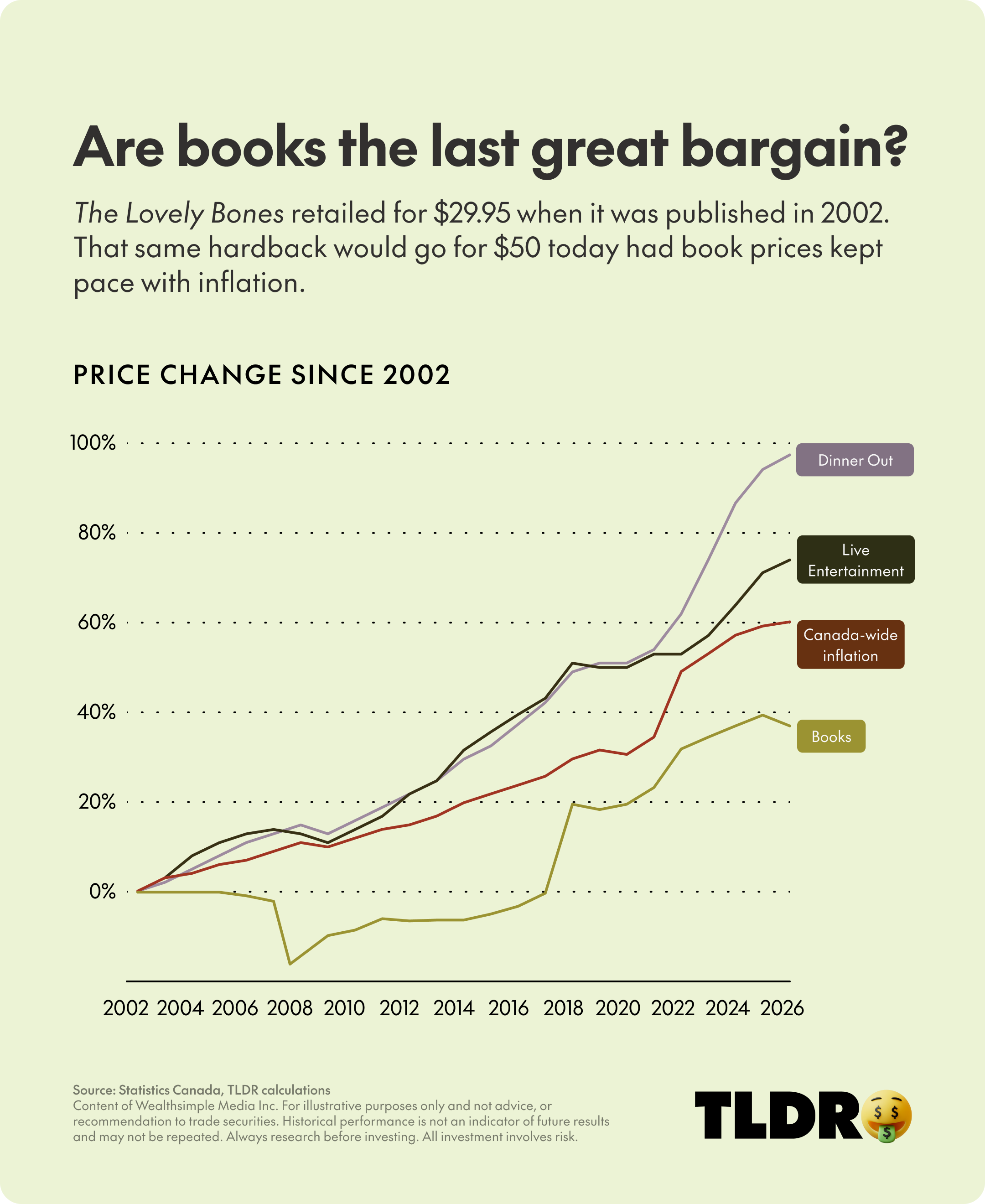 | | |
Will fightin’ words turn into another Whisky War? Canada’s CUSMA talks with the U.S. are facing a 150-proof problem: Ontario, Quebec, and B.C. still refuse to stock American liquor, which U.S. Commerce Secretary Howard Lutnick called “insulting and disrespectful” last week. Maybe what he recently dubbed “the worst [trade] strategy I’ve ever heard” is, in fact, getting under his skin? The liquor boycott isn’t the Trump administration’s only grievance, but it’s a costly one: Ontario, Canada’s largest alcohol market, sold US$705 million worth of American booze in 2024. Last year: zero. Ontario Premier (and ex-Trump fan) Doug Ford is vowing not to back down until “we get the deal done.” | |
Soaring oil costs are grounding airlines. Air Canada just cut a half-dozen routes, including some NYC flights. Air Transat is slashing 6% of its schedule. United: 5%. Delta: 3.5%. Maybe you’re thinking, Wait — doesn’t North America have tons of oil? Yes, but that isn’t shielding airlines from price spikes, because in recent years they’ve shifted from buying fuel at slightly elevated future prices, known as fuel hedging, in favour of paying lower spot prices. It’s a sound strategy — until a confusing war shuts down the Strait of Hormuz, spot prices soar, your stock plummets, and suddenly everyone’s taking road trips this summer. | |
Coffee snobs: Wall Street needs you. Did you know that on the eighth floor of the New York Stock Exchange, a panel of 38 official coffee graders spends all day rating beans and tasting coffee to set the world’s arabica future prices? Neither did we! How do you get that job? Well, that’s the problem: the graders are getting old, The Wall Street Journal reports, and the four-day test to replace them is a brutal ordeal, with subtle notes of bile and terror. Fail any stage and you have to start over. Pass rate: less than 8%. Also, the test is only offered about once every five years. But if you do pass, you’ll be rich because you’ll never pay for coffee again! | |
We lost the Webby ☹️. But it was an honour just to be nominated (again, heh)! And because TLDR is an all-class publication, we’d like to congratulate Arthur C. Brooks, the conservative pundit turned happiness guru, on his richly deserved victory and discourage you from reading this ruthless takedown of his latest book. |
TLDR PSA: Tax Day is Thursday! Here’s our guide to big life moments that could affect your return.
—Abigail Covington & Brennan Doherty
|  | | The FOMO Index | | by Stacey Woods | | Important | | 🚢 | The Iran war will likely raise the price of condoms. Pressure mounting to fully pull out.
Source | | | | 🧊 | Fire crews destroy Drake’s promotional ice sculpture in downtown Toronto. Meanwhile Kendrick Lamar’s Compton nacho fountain is standing strong.
Source | | | |  | |  |
| 🧅 |
The Onion reaches a deal to take over Infowars. Future Onion headline: “Onion Headline Writers Write Headline With More Layers of Irony Than Actual Onion.”
Source | | | | 💉 | Amazon launches a comprehensive GLP-1 weight-loss program. Gotta do something if people aren’t going to buy those Fiesta Size Takis.
Source | | | | | | Crash & Burn | |  | | To the Moon | | | ☕ | Starbucks drops secret Devil Wears Prada 2 menu across Canada. (Assistant you can berate for botching your order included.)
Source | | | | 🎶 | Madonna offers a reward for her missing Coachella outfits. Says she’ll trade you a slightly used cone bra, no questions asked.
Source | | | | |  | |  | | 🚬 | U.K. passes lifetime smoking ban for anyone born after 2008. They will henceforth be known as “Gen ZYN.”
Source | | | | 🍤 | Red Lobster brings back Endless Shrimp for a limited time. After that, we’re all back on Maintenance Dose Shrimp.
Source | | | | | | | Who Cares? | | | The Big Important Story | | Is the Stock Market Finally, Actually Overvalued? | If you’ve followed markets at all over the past, oh, 15 years, you know there’s been a long-running debate about stock valuations — i.e., whether stocks are overpriced relative to corporate earnings. The debate has intensified since 2022, when AI optimism began launching stock prices to frothy new stratospheres. And yet despite doomers’ constant warnings that stocks are overvalued and the mother of all crashes is nighish, they just keep on climbing.
A new paper by economists at the Minneapolis Federal Reserve Bank argues that there’s a perfectly non-crazy explanation: while stocks look awfully expensive by one of Wall Street’s favourite metrics, one lesser-known indicator suggests that stocks are, in fact, priced pretty fairly. Or at least they were until recently. Let’s dive in. | | | The problem with the P/E ratio | Wall Street doomers often point to the price-to-earnings (P/E) ratio, a popular tool for measuring value, when arguing that stocks are expensive, not least because the S&P’s P/E ratio has been cruising well above its historical average of 17 for years now. But the Minnesota Fed’s core insight is that the P/E ratio is not as foolproof as advertised because it relies on GAAP earnings, an accounting metric that doesn’t subtract all the money firms plow back into factories and other equipment — which is money that never actually reaches shareholders.
From the 1950s to the 1980s, the U.S. (see chart below) and Canada were dominated by firms that poured mountains of cash into factories, computers, and other equipment, making their earnings look giant — and their P/E ratio nice and low — when in reality they were returning far less cash to investors than their P/E ratio implied. | 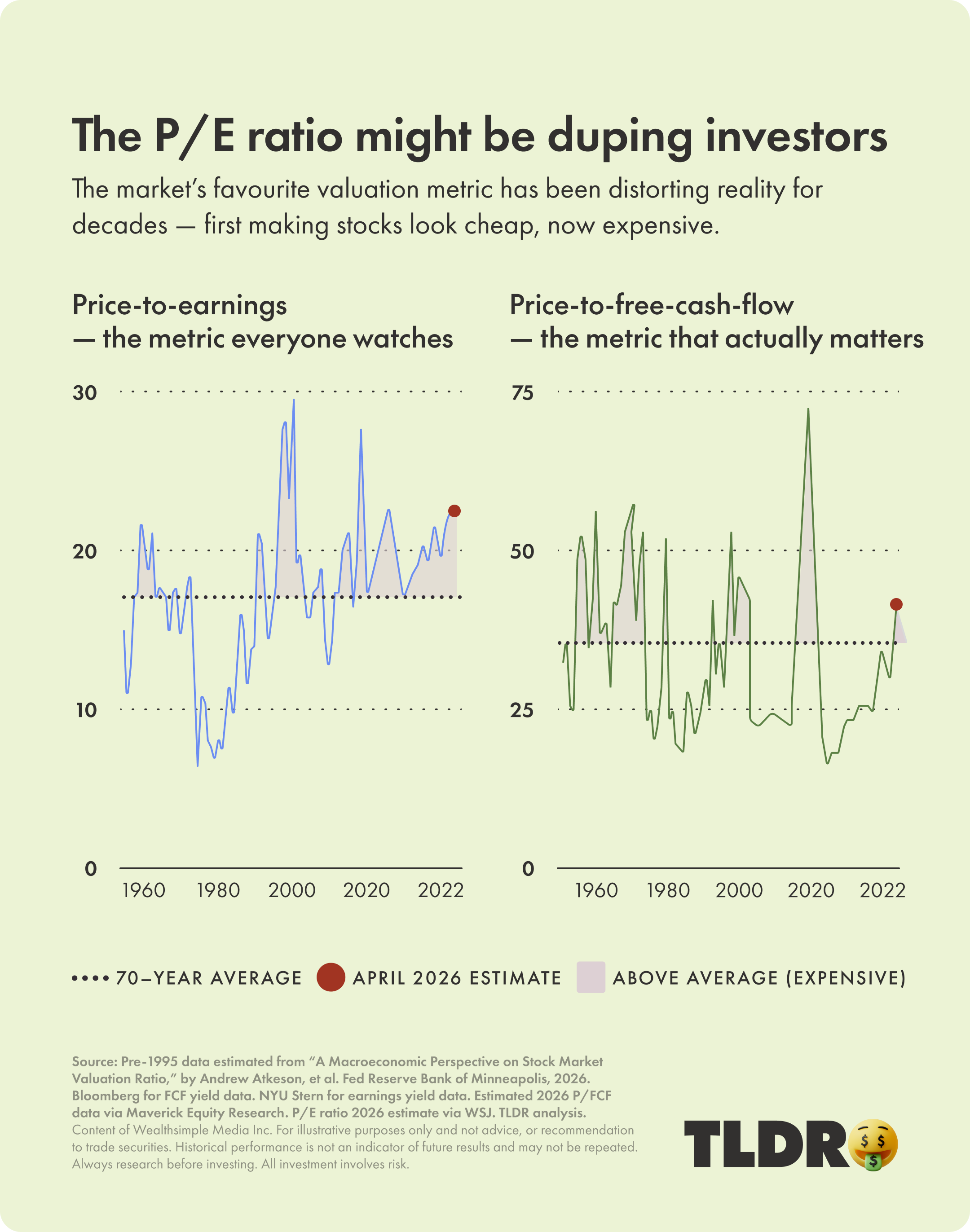 | A far better tool to gauge value, the Fed paper argues, is price relative to free cash flow, or P/FCF, a metric that excludes all the cash companies spend on capital expenditures, like factories. “It’s a measure of everything that’s left at the end … to be paid to the owners [and investors] of the firm,” Jonathan Heathcote, one of the paper’s co-authors, said recently on Odd Lots.
P/FCF helps to explain why shares in today’s largest companies haven’t tanked, despite the S&P 500’s persistently high P/E: most big companies have offices full of well-paid white-collar workers, not giant factories to power and maintain. And their large payrolls make their P/E ratio appear high because worker wages, unlike capex spending, are a significant line item in corporate GAAP earnings. But today’s companies still haul in piles of cash for shareholders. Hence the S&P has stayed below its P/FCF historical average of 30 for much of the past decade — so maybe it’s not overvalued after all. | | The AI twist in this valuation story | In recent years, tech giants have been investing fortunes into AI data centres and chips and pricey software engineers, burning through much of the cash that they would have returned to investors in years past. Which explains why the S&P’s P/FCF has finally shot north of its average. Does that mean a crash is coming? Not necessarily. Big tech’s AI investments could boost cash flows and make their stock prices look reasonable. It hasn’t happened yet, though, and the stakes keep rising.
—Jared Sullivan
| | The Wisdom of X | |
 | | Thoughts on Today’s Issue? | | | | | This week’s newsletter contributors: Brennan Doherty (writer), Devin Gordon (writer), Stacey Woods (writer), Ambrose Martos (fact checker), Ciara Rickard (copy editor), Maude Campbell (copy editor), Sara Black McCulloch (fact checker), Eva Grace Clement Cruz (specialist, product engagement), Lauren Edwards (production coordinator), Matthew Karasz (markets editor), Jared Sullivan (senior editor), Peter Martin (senior editor), and Devin Friedman (editor-in-chief).
TWIM: Total returns shown in local currency, via TradingView. | | | |