
|
|
PRESENTED BY
|

|
|
Here's what you'll find in this issue: - **This founder launched** his MVP in two months instead of going for a perfect product. - **5 vibe coding tools.** Some of the latest apps for coding with AI. - **Yesterday's build board winners,** including t
Here's what you'll find in this issue:
-
This founder launched his MVP in two months instead of going for a perfect product.
-
5 vibe coding tools. Some of the latest apps for coding with AI.
-
Yesterday's build board winners, including three new product launches from indie hackers.
-
30-second growth tip: Send partners a checklist so their intern can promote you.
You launched, but the growth is chaos. You’re trying everything, but the signals are buried in the noise. Finding your first 100 users is a grind. PopHatch is your 24/7 partner that thinks through the mess with you, remembers every test, and helps you iterate until it works. Founder pricing open now.
This founder launched his AI monitoring SaaS in 2 months ⚡️

When Daniel Peris saw brands appearing in AI-generated answers, he didn’t write a strategy doc. He and his co-founders built and launched an MVP for LLM Pulse in just two months. Less than a year later, the bootstrapped, three-person team is at a mid-five-figure MRR in a category that barely existed when they started. Speed has always mattered in startups, but in the LLM era it matters more than ever.
LLM Pulse helps brands monitor and improve how they show up in AI search platforms like ChatGPT and Perplexity.
In our interview with Daniel, he breaks down how they operate in a space with no playbooks. He also explains why doing tons of demos is their primary source of learning, their minimalist approach to SEO that avoids content for content's sake, and how past mistakes were the key to moving so fast this time. This one is a great blueprint for building in a brand new market.
Read the full article →
You have docs about your startup. Your AI has no idea they exist. 🧠
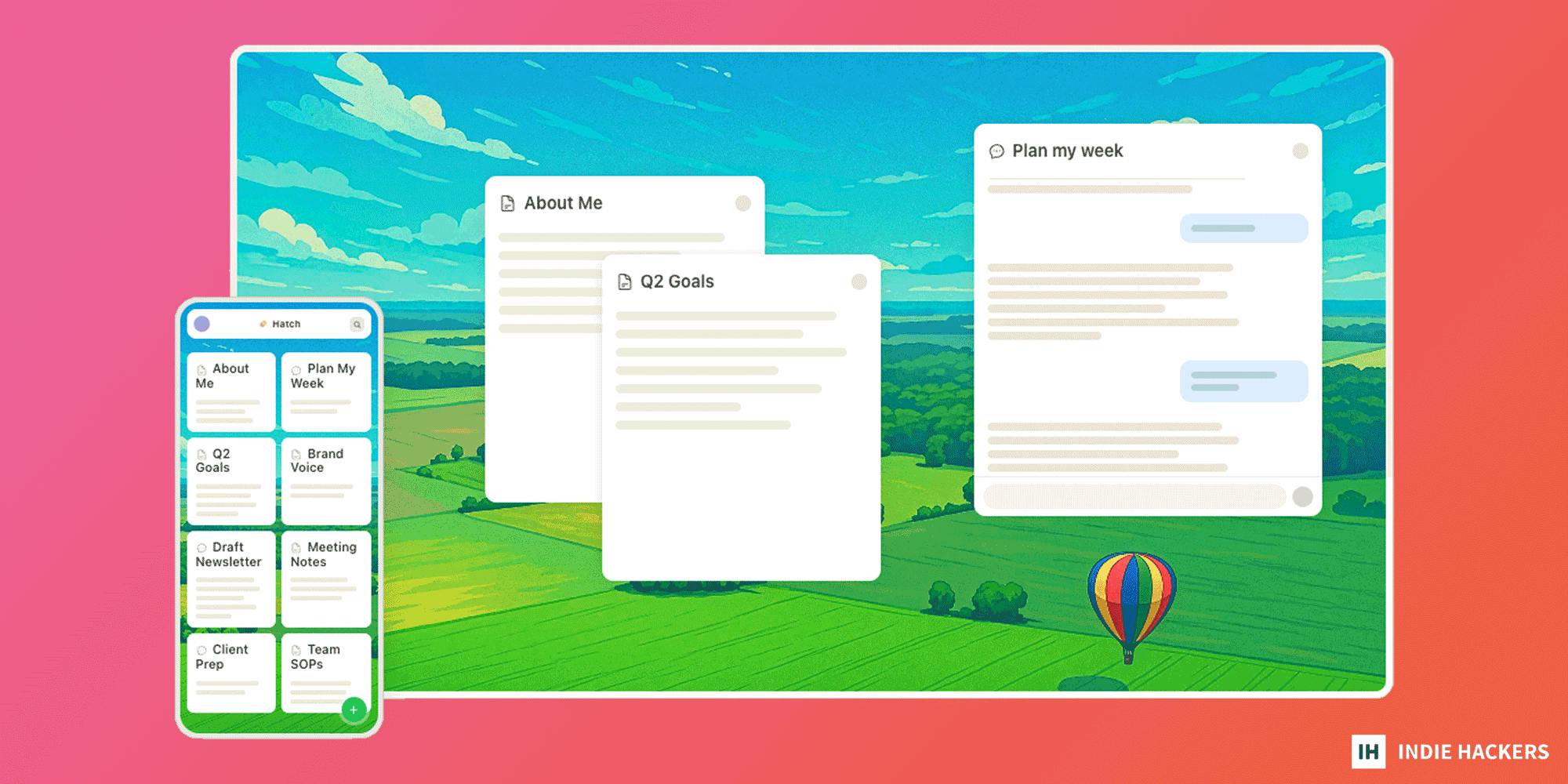
Think about everything you know about your business: your ideal customer profile, your pricing rationale, your competitive landscape, your roadmap, your lessons learned. It's probably scattered across Google Docs, Notion pages, and your own head.
Now think about how much of that your AI can actually use when you ask it a question.
None of it.
Hatch is an AI assistant where your docs and your chats live in the same app... and they talk to each other. Write docs about your business (or get the AI to write them!), tag them in any conversation, and your AI reads them before it responds. Not a summary. Not a pasted snippet. The whole thing.
What that means in practice:
- Write your ideal customer profile once → every marketing chat knows your customer, your positioning, and your voice
- Keep a running startup journal → ask “what should I focus on this week?” and get an answer based on what you've actually shipped and learned
- Store your SOPs and playbooks → get help that follows your process, not generic five-step guides from the internet
- Open any combination of chats and docs side by side in floating windows → work on multiple problems at once without losing context
Works on desktop, mobile, and offline. A guided tutorial gets you going in 2 minutes. Built by us... the founders of Indie Hackers. :)
Try Hatch free. Use code INDIE30FREE for 100% off for 1 month.
Vibe coding tools to try 🧑🏻💻

-
Hatch: All-in-one AI workspace for chats, documents, and files that understands your whole project. From the founders of Indie Hackers. :)
-
Continue: Create custom AI copilots in VS Code or JetBrains with one open-source plugin.
-
v0: Type a prompt — v0 drafts production-ready React, Vue, or Svelte components.
-
Qodo: Boost test coverage fast — Qodo writes unit tests and smart code suggestions.
-
Bolt.new: Prompt an app — Bolt spins up and deploys the full-stack in one click.
See all 30 tools in the directory →
Bite-sized growth tip 🍪

Send partners a checklist so their intern can promote you.
Wade Foster, Brian Helmig, and Mike Knoop built Zapier into a $250M/year business by connecting software tools together. Every new integration meant a new partner. But partnerships usually die after the handshake because nobody knows what to do next.
Zapier fixed this with a co-marketing checklist. Literal to-do items sent to every new partner: "List Zapier in your app store." "Add us to your integrations page." Etc. Copy-paste ready.
This scales beautifully. Zapier has thousands of integrations. They can't build deep relationships with every partner. But they can hand everyone the same playbook and let partners self-serve on promotion.
Don't assume partners will figure out how to help you. Spell it out. Make each item so specific that a marketing intern could execute it without asking a single question. The easier you make it, the more likely it actually happens.
Read the full growth report →
The Build Board 🪧

Every day, indie hackers post updates about the products they're building. Here's what the community voted to the top yesterday!
Enjoy building in public? Post an update to your product page on Indie Hackers, and it will automatically be added to the daily leaderboard.
Channing's Tweet Pick 🐦
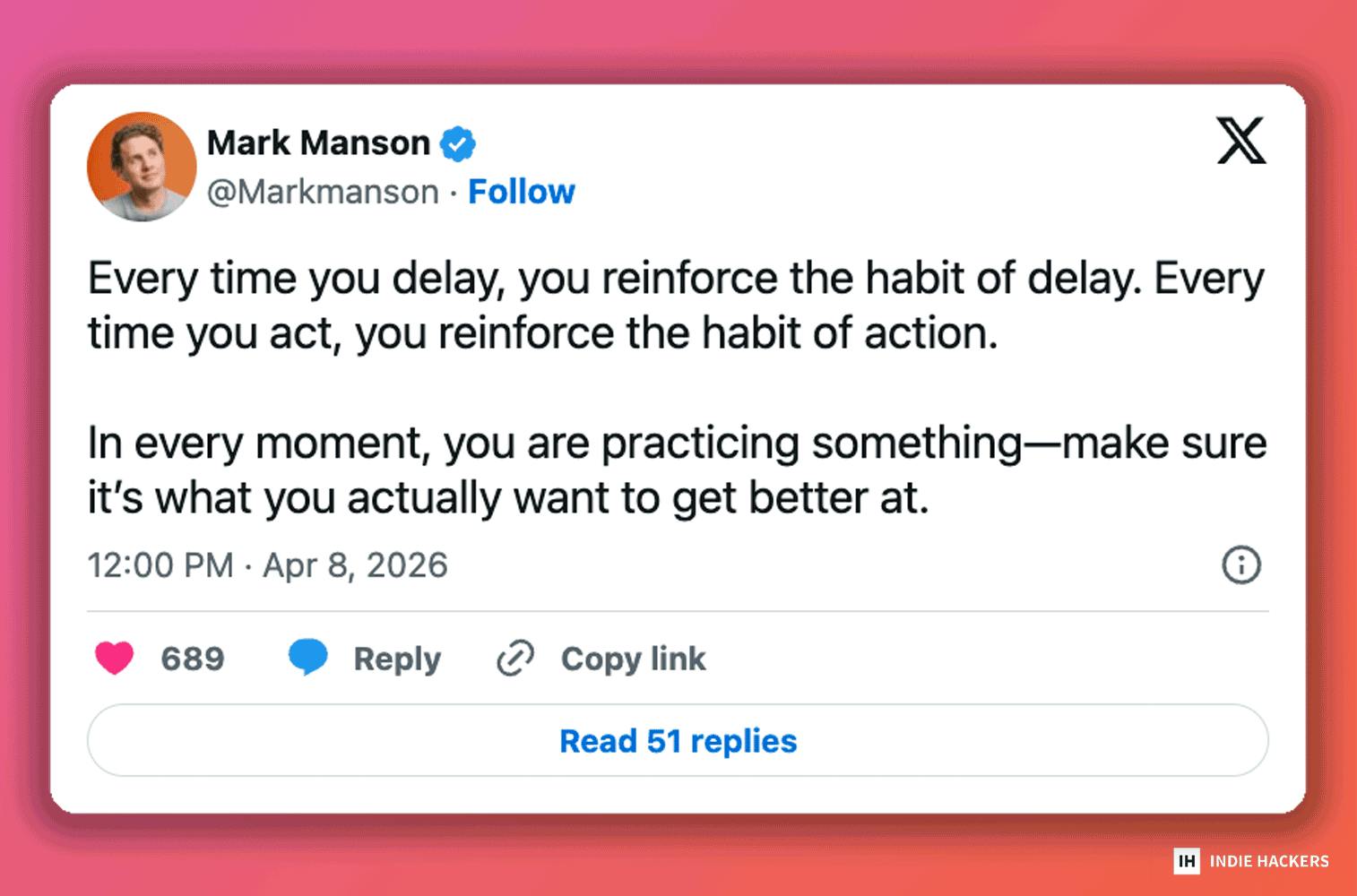
What habit will you practice immediately after reading this newsletter issue?
—Channing
We'd love your feedback! 🙃
Did you like today's stories? Did they suck? Which ones?
We're constantly changing things up to make this newsletter more useful, so let us know what you think by replying directly to this email. We read every reply!
Special thanks to Yushavel Calderon for the graphic design, and to James Fleischmann for contributing a post.
—Channing
|
|
|
Indie Hackers | 120 Westlake Avenue N, Seattle, Washington 98109
|
|
You're subscribed to the Indie Hackers Newsletter. Click here to unsubscribe.
|
|
|


